Hard Braking Spike Coincides With Deadliest Month for Pedestrians
Alaska had the highest increase in hard braking, but the dangerous driving habit rose in all 50 states during October, report finds.
Published | Reading time: 2 minutes
October is the deadliest month for pedestrians, federal data shows, and more drivers slam on their brakes in October — possibly trying to avoid collisions with other cars or pedestrians — than in any other month, according to a new telematics report.
Hard braking peaks in October, which is also National Pedestrian Safety Month, according to CMT.AI, a company that provides telematics technology and data. All 50 states saw an increase in hard braking during the month, and nationally, October hard braking rates are 6% higher than the annual average.
On average, between 2020 and 2024, October saw 27% more pedestrian crashes that resulted in fatalities and injuries than in an average month, CMT.AI reported, citing the National Highway Traffic Safety Administration’s (NHTSA) Fatality and Injury Reporting System Tool.
Hard braking occurs when a driver must use more force than usual to stop their vehicle. Some commercial fleet managers consider a one-second reduction in speed of 8–10 mph to be hard braking.
“Insurance companies typically consider hard braking a risky driving behavior because it can mean the driver is distracted, aggressive, or miscalculating stopping distances,” says Julia Taliesin, an economic analyst for Insurify who’s also a licensed insurance agent. “All those factors increase your risk of getting into an accident.”
Common reasons for hard braking include following too closely to another vehicle, delayed reaction to changing driving conditions, or failing to anticipate impending stops, Taliesin says. “Hard braking can happen near crosswalks and on roadsides if a driver hasn’t been attentive to pedestrians in the area.”
“Hard braking can indicate moments when drivers need to react quickly to avoid a potential collision,” according to CMT.AI’s report. “While not every hard braking event represents a near miss, CMT.AI research has found that drivers with the highest rates of hard braking are 1.7 times more likely to be involved in a crash.”
CMT.AI’s report noted that the peak in October is likely part of a larger seasonal pattern that sees pedestrian accidents increase in the fall — when cooler weather makes it easier to be outdoors — and decline in the winter as temperatures drop.
NHTSA data shows pedestrian fatalities and injuries regularly increase in October, and — perhaps unsurprisingly — are more common in urban areas. In 2024, 76% of pedestrian deaths happened at night, when pedestrians are more difficult to see. And in 24% of fatalities, the driver fled the scene.
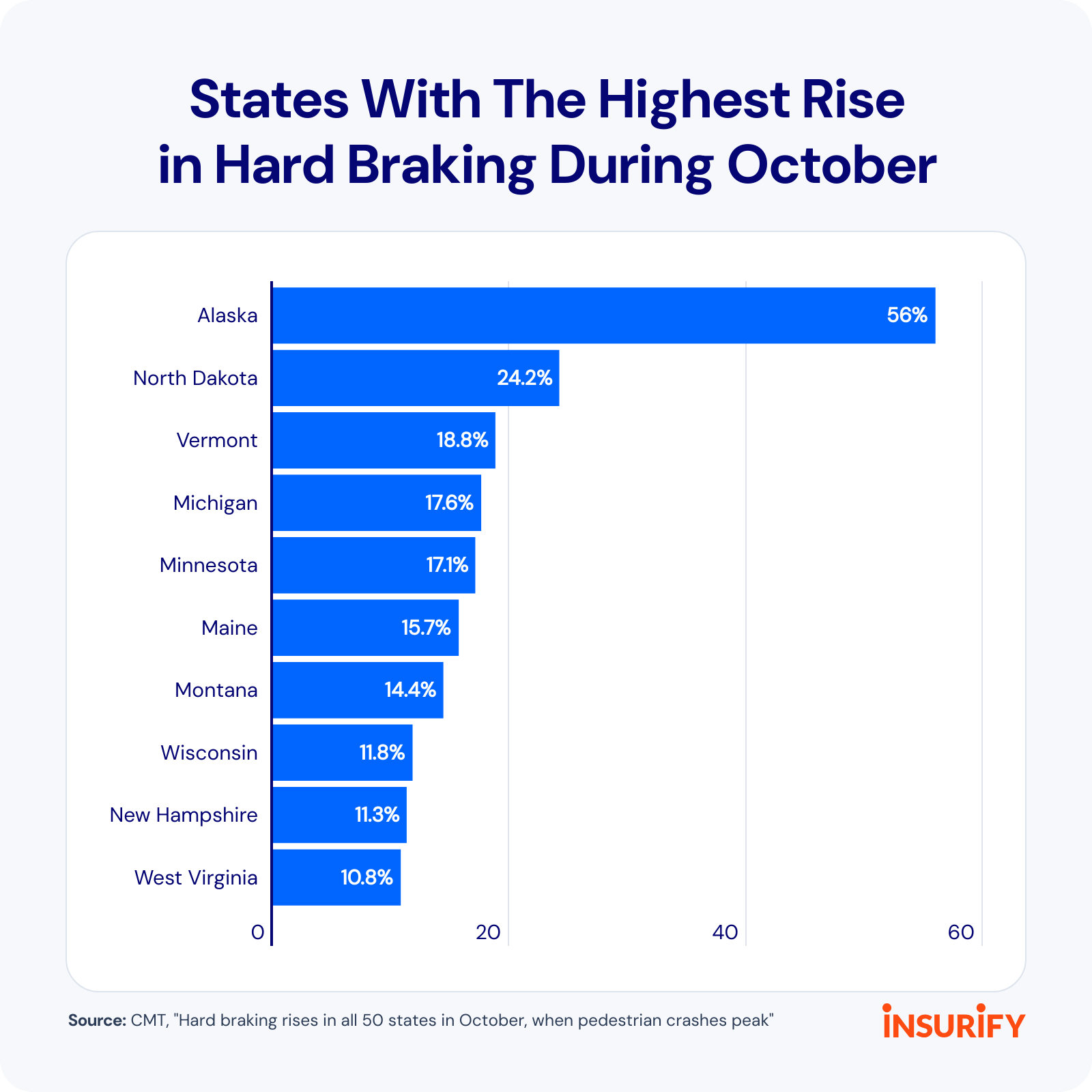
Alaska saw the greatest increase in hard braking during October, at 56%, CMT.AI reported. A good chunk of states (20) experienced increases of 5% or less. Hard braking rose 5%–10% in 18 states, 10%–15% in six, 15%–20% in four, and 20% or more in just two states.
“Across the country, drivers were braking suddenly more often during the same month that pedestrian crashes reached their highest levels,” CMT said.
To raise awareness during National Pedestrian Safety Month, the NHTSA offers some tips for both drivers and walkers:
Pedestrians should follow the rules of the road, including always crossing the road at a crosswalk whenever one is available. When no crosswalk is available, pick a well-lit area with good visibility to cross.
Stay on sidewalks whenever available. If there’s no sidewalk, walk facing traffic and as far away from moving vehicles as possible.
Drivers should follow speed limits, especially in areas with heavy pedestrian traffic, such as school zones.
Use extra caution when driving at night or in bad weather, times when pedestrians are harder to see.
Always yield to pedestrians, and keep your distance from people walking in crosswalks so that your vehicle doesn’t block others from seeing pedestrians.
At Insurify, our goal is to help customers compare insurance products and find the best policy for them. We strive to provide open, honest, and unbiased information about the insurance products and services we review. Our hard-working team of data analysts, insurance experts, insurance agents, editors and writers, has put in thousands of hours of research to create the content found on our site.
We do receive compensation when a sale or referral occurs from many of the insurance providers and marketing partners on our site. That may impact which products we display and where they appear on our site. But it does not influence our meticulously researched editorial content, what we write about, or any reviews or recommendations we may make. We do not guarantee favorable reviews or any coverage at all in exchange for compensation.